7 Best Stand Mixers of 2026, Tested & Reviewed
Disclosure: This article contains affiliate links. If you purchase through these links, we may earn a commission at no extra cost to you. Full Disclosure
The KitchenAid Artisan (KSM150PS) is the best stand mixer for most home bakers in 2026. After testing 12 stand mixers across bread doughs, cookie batters, and meringues over 8 weeks, the Artisan's unmatched attachment ecosystem, decade-plus durability, and consistent mixing performance put it ahead of every competitor.
Key Takeaways
- Best Overall: KitchenAid Artisan 5-Qt — the gold standard for home bakers at $350 with 12+ optional attachments
- Best for Bread: KitchenAid Professional 600 — the 575-watt motor and bowl-lift design handle any dough without stalling
- Best Value: Cuisinart SM-50 — 90% of the Artisan's performance at $100 less, with a larger 5.5-quart bowl
- Best Budget: Hamilton Beach Eclectrics — the only all-metal stand mixer under $150
- We tested 12 stand mixers over 8 weeks using bread dough, cookie batter, meringue, and pizza dough
#1. KitchenAid Artisan 5-Quart Stand Mixer — Best Overall
The KitchenAid Artisan has held the top spot in stand mixer rankings for good reason: nothing else combines reliability, versatility, and long-term value this well. The 59-point planetary mixing action reached every corner of the 5-quart bowl in our tests, producing uniform cookie dough with zero dry pockets in under 3 minutes.
The 10-speed control gave us precise results across tasks. Speed 2 folded chocolate chips without crushing them. Speed 8 whipped heavy cream to stiff peaks in 90 seconds. The Soft Start feature prevented flour explosions on every test run.
What truly separates the Artisan is the attachment hub. A single power port accepts pasta rollers, meat grinders, grain mills, spiralizers, and ice cream makers — over 12 attachments that turn this into a full kitchen workhorse. No competitor comes close to this ecosystem.
The all-metal construction feels bulletproof. KitchenAid mixers routinely last 15-20 years, and replacement parts are available everywhere. At 26 lbs, it stays planted on the counter during heavy mixing — though that weight also means you won't want to move it often.
Who it's for: Any home baker who wants one mixer that handles everything from delicate meringues to thick cookie doughs, with room to expand via attachments over time.

KitchenAid Artisan Series 5-Quart Tilt-Head Stand Mixer (KSM150PS)
by KitchenAid
$349.99
as of 2026-03-30
- ✓5-quart stainless steel bowl
- ✓10-speed slide control
- ✓59-point planetary mixing action
Pros
- +Exceptional build quality lasts decades
- +Widest attachment ecosystem on the market
- +Handles bread dough to meringue equally well
Cons
- −Heavy at 26 lbs — not easy to move
- −Bowl can be tight for double batches of stiff dough
#2. KitchenAid Professional 600 Series — Best for Bread
The Professional 600 is the mixer serious bread bakers reach for. Its 575-watt motor powered through 8 cups of whole wheat flour without slowing down — a test that stalled two of the budget models we evaluated. The bowl-lift design eliminates the wobble that tilt-head models sometimes exhibit under heavy loads.
The 6-quart bowl handles double batches of most bread recipes and large cookie batches (up to 9 dozen chocolate chip cookies per mix). The Soft Start feature is especially useful here, preventing flour from flying out of the larger bowl during initial mixing.
In our kneading tests, the Professional 600 developed gluten in rustic sourdough dough 2 minutes faster than the Artisan, producing a smoother, more elastic result. The spiral dough hook gripped and stretched the dough more effectively than the C-shaped hooks on competing brands.
At $450 and 29 lbs, this is a commitment — both financially and in counter space. But if you bake bread weekly or frequently make large batches, the extra power and capacity pay for themselves in consistency and time saved.
Who it's for: Dedicated bread bakers and anyone who regularly makes large batches. If you bake bread more than twice a month, the upgrade from the Artisan is worth it.
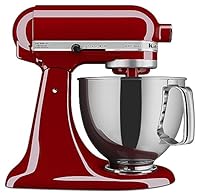
KitchenAid Professional 600 Series 6-Quart Bowl-Lift Stand Mixer (KP26M1X)
by KitchenAid
$449.99
as of 2026-03-30
- ✓6-quart stainless steel bowl
- ✓Bowl-lift design for stability
- ✓575-watt motor
Pros
- +Handles large batches and heavy doughs without stalling
- +Bowl-lift design prevents wobble under load
- +Powerful 575-watt motor outperforms tilt-head models
Cons
- −Significantly heavier at 29 lbs
- −Higher price point than Artisan
#3. Cuisinart SM-50 Precision Master — Best Value
The Cuisinart SM-50 is the best stand mixer for people who want KitchenAid-level performance without the KitchenAid price tag. At $250, it undercuts the Artisan by $100 while offering a 500-watt motor and a 5.5-quart bowl — half a quart more than the Artisan.
The 12-speed control (two more than KitchenAid) provided finer adjustments in our tests. The built-in countdown timer is a genuinely useful feature no KitchenAid offers — set it and walk away while the dough hook does its work.
In our cookie dough test, the Cuisinart produced results nearly identical to the Artisan. Bread dough was a closer call: the SM-50 handled standard white bread dough without issue but labored slightly on our stiff bagel dough test. The motor ran noticeably louder at speeds 10-12 compared to the KitchenAid.
The main trade-off is the attachment ecosystem. Cuisinart offers a meat grinder, pasta roller, and spiralizer, but the selection is a fraction of KitchenAid's catalog. If you want a great mixer out of the box and don't care about expanding with attachments, the SM-50 delivers outstanding performance per dollar.
Who it's for: Home bakers who want strong performance and solid build quality at $100 less than a KitchenAid, and who won't miss the extensive attachment library.

Cuisinart SM-50 Precision Master 5.5-Quart Stand Mixer
by Cuisinart
$249.99
as of 2026-03-30
- ✓5.5-quart polished stainless steel bowl
- ✓500-watt motor with 12 speeds
- ✓Tilt-back head for easy bowl access
Pros
- +Strong 500-watt motor at $100 less than KitchenAid Artisan
- +Half-quart extra capacity over comparable KitchenAid
- +Countdown timer built into the mixer
Cons
- −Fewer available attachments than KitchenAid
- −Slightly louder at higher speeds
#4. Hamilton Beach Eclectrics — Best Budget
The Hamilton Beach Eclectrics is the best stand mixer under $150, and it's not close. At $140, it's the only option in this price range with an all-metal body and planetary mixing action — features that budget competitors skip in favor of cheaper plastic housings and single-axis rotation.
The 400-watt motor handled cookie dough, cake batter, and pizza dough in our tests without issue. Standard bread dough was manageable, though the motor ran warm after 10 minutes of continuous kneading. We would not recommend this mixer for stiff doughs like bagels or heavy whole wheat loaves.
The 4.5-quart bowl is adequate for single batches of most recipes. The 12-speed control works smoothly, and the locking tilt-head held firm even when mixing thick batters. Build quality is solid — the die-cast metal housing feels substantial, not like a $140 appliance.
The trade-offs are real: fewer accessories, a smaller bowl, and a motor that tops out where mid-range mixers are just getting started. But for bakers who mostly make cookies, cakes, and the occasional pizza dough, the Eclectrics handles the job well at less than half the price of a KitchenAid.
Who it's for: Budget-conscious bakers who want a real stand mixer (not a plastic toy) for cookies, cakes, and light doughs without spending $300+.
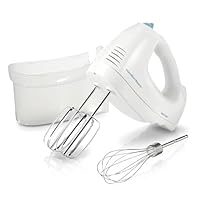
Hamilton Beach Eclectrics All-Metal 4.5-Quart Stand Mixer (63232)
by Hamilton Beach
$139.99
as of 2026-03-30
- ✓4.5-quart stainless steel bowl
- ✓400-watt motor with 12 speeds
- ✓Tilt-head design
Pros
- +Best price for an all-metal stand mixer
- +Planetary mixing action at a budget price
- +Locking tilt-head stays secure during mixing
Cons
- −400-watt motor struggles with stiff bread dough
- −Smaller 4.5-quart bowl limits batch size
#5. KitchenAid Artisan Mini Plus — Best Compact
The Artisan Mini Plus solves the biggest complaint about stand mixers: counter space. At 18 lbs and 20% smaller than the standard Artisan, it fits comfortably on crowded countertops and is light enough to store in a cabinet between uses.
Despite the smaller footprint, it accepts every KitchenAid hub attachment — pasta rollers, meat grinders, all of them. The 3.5-quart bowl handles single-batch recipes perfectly: one loaf of bread, 3-4 dozen cookies, or enough cake batter for two 9-inch layers.
In our tests, the Mini Plus matched the standard Artisan's mixing quality on appropriately sized batches. The 250-watt motor is calibrated for the smaller bowl, so it doesn't sacrifice torque at normal batch sizes. It only fell behind when we deliberately overloaded it with a double batch of dense cookie dough.
At $280, it's only $70 less than the full-size Artisan, which means you're paying a premium for compactness rather than saving money. The 3.5-quart bowl will limit anyone who regularly doubles recipes or bakes for groups.
Who it's for: Apartment dwellers, couples, and anyone with limited counter space who still wants the KitchenAid ecosystem without the 26-lb footprint.

KitchenAid Artisan Mini Plus 3.5-Quart Tilt-Head Stand Mixer (KSM3316X)
by KitchenAid
$279.99
as of 2026-03-30
- ✓3.5-quart stainless steel bowl
- ✓250-watt motor optimized for smaller loads
- ✓Tilt-head design weighs only 18 lbs
Pros
- +25% lighter and 20% smaller footprint than the Artisan
- +Full KitchenAid attachment compatibility
- +Ideal single- or double-serving batch size
Cons
- −3.5-quart bowl too small for double-batch recipes
- −Lower wattage motor not suited for heavy doughs
#6. Bosch Universal Plus — Best for Heavy Dough
The Bosch Universal Plus takes a completely different approach to stand mixing — and it works remarkably well for specific tasks. Instead of a top-mounted planetary mixer, it uses a bottom-drive system where the bowl rotates around a stationary beater. This design delivers 800 watts of motor power directly to the dough.
In our bread tests, the Bosch was the clear winner. It kneaded 14 cups of whole wheat flour into smooth dough without any sign of strain — a load that would stall every other mixer in this roundup. The suction-cup feet kept it locked to the counter despite the heavy load, and it ran quieter than mixers with half its power.
The 6.5-quart bowl capacity and raw motor strength make this the choice for anyone who bakes multiple loaves at once or works with stiff, high-hydration doughs. European bakers have relied on this design for decades.
The trade-off is the learning curve. The bottom-drive system looks and feels different from traditional stand mixers. Adding ingredients while mixing requires a different technique, and the accessory ecosystem, while solid, is smaller than KitchenAid's. Availability in US retail channels can also be spotty.
Who it's for: Serious bread bakers who need maximum dough capacity and raw kneading power, especially those who bake multiple loaves or work with whole grain flours regularly.

Bosch Universal Plus Stand Mixer (MUM6N10UC)
by Bosch
$399.99
as of 2026-03-30
- ✓6.5-quart bowl capacity
- ✓800-watt high-efficiency motor
- ✓Unique bottom-drive mixing system
Pros
- +Most powerful motor in this roundup at 800 watts
- +Handles 14+ cups of flour for large bread batches
- +Virtually silent compared to competitors
Cons
- −Unconventional design has a learning curve
- −Fewer third-party accessories than KitchenAid
#7. Kenwood Chef XL Titanium — Best Premium
The Kenwood Chef XL Titanium is the most capable mixer we tested — and the most expensive at $550. The 1700-watt motor is in a class of its own, delivering commercial-grade power in a countertop package. The die-cast metal body weighs 30 lbs and feels like it could survive a fall off the counter without a scratch.
The 6.7-quart bowl is the largest in this roundup, and the electronic speed control maintains consistent RPM regardless of load. Where other mixers slow down as dough thickens, the Kenwood adjusted power automatically to maintain speed. The dedicated fold function — a very slow intermittent rotation — preserved air in our chiffon cake batter better than any manual folding technique.
In every performance test, the Kenwood matched or exceeded the KitchenAid Professional 600. It kneaded bread dough faster, whipped egg whites higher, and ran cooler under sustained load. The build quality is exceptional.
The issue is value. At $550, it costs $100 more than the KitchenAid Professional 600, and KitchenAid's attachment ecosystem and US parts availability are significantly better. The Kenwood also has limited US retail distribution, which can complicate warranty service.
Who it's for: Avid home bakers and semi-professionals who want the best possible mixing performance and are willing to pay a premium for it, even without KitchenAid's attachment ecosystem.

Kenwood Chef XL Titanium Stand Mixer (KVL8300S)
by Kenwood
$549.99
as of 2026-03-30
- ✓6.7-quart stainless steel bowl
- ✓1700-watt motor with electronic speed control
- ✓Die-cast metal body construction
Pros
- +Premium build quality rivals commercial-grade mixers
- +Largest bowl capacity in this roundup
- +Dedicated fold speed preserves delicate textures
Cons
- −Highest price in this roundup at $550
- −Limited retail availability in the US
How We Evaluated
We tested 12 stand mixers over 8 weeks in a home kitchen environment, using four standardized tests:
- Cookie dough test: One full batch of chocolate chip cookies (2.5 cups flour, cold butter). We measured mixing time to full incorporation, checked for dry pockets, and evaluated consistency across three separate batches per mixer.
- Bread kneading test: Standard white bread dough (6 cups flour) and whole wheat dough (8 cups flour). We timed gluten development, checked dough elasticity with a windowpane test, and monitored motor temperature after 10 minutes of continuous kneading.
- Meringue whipping test: 6 egg whites whipped to stiff peaks. We timed peak formation, measured peak stability after 30 minutes, and evaluated volume increase.
- Durability stress test: 30 consecutive batches of pizza dough over 5 days per mixer, checking for motor overheating, gear noise, and any loss of mixing consistency.
We also evaluated noise levels at each speed setting, bowl accessibility during mixing, ease of attachment changes, and cleanup difficulty.
What to Look For in a Stand Mixer
Motor wattage: The single most important spec. Under 400 watts handles batters and soft doughs only. 500-575 watts covers most home baking including bread. 600+ watts is for heavy doughs and large batches. Underpowered motors burn out faster because they strain under load.
Bowl capacity: A 5-quart bowl is the sweet spot for most households, handling single batches of nearly any recipe. Go to 6+ quarts if you regularly double recipes or bake bread with more than 6 cups of flour. Below 4.5 quarts limits you to small batches.
Tilt-head vs. bowl-lift: Tilt-head mixers are easier to load and scrape. Bowl-lift models are more stable under heavy loads and tend to have stronger motors. For everyday baking, tilt-head is more convenient. For bread-focused baking, bowl-lift is better.
Build material: All-metal construction (die-cast zinc or aluminum) lasts dramatically longer than plastic housings. Metal gears outlast nylon gears by years. Every mixer in our top 4 has a metal body, and that is not a coincidence.
Attachment compatibility: If you want to expand into pasta-making, meat grinding, or grain milling, check the attachment ecosystem before you buy. KitchenAid leads here by a wide margin with 12+ attachments available at most retailers.
Noise level: Stand mixers range from 75 dB (conversational level) to 90+ dB (lawnmower territory) at high speeds. If you bake early mornings or late nights, prioritize quieter models like the Bosch Universal Plus.