8 Best Knife Sharpeners for Beginners (2026 Tested)
Disclosure: This article contains affiliate links. If you purchase through these links, we may earn a commission at no extra cost to you. Full Disclosure
The Chef'sChoice ProntoPro 4643 is the best knife sharpener for beginners in 2026. After testing 14 sharpeners across dull chef's knives, paring knives, and serrated blades over 4 weeks, the ProntoPro's foolproof angle guides, three-stage diamond sharpening system, and ability to handle both 15-degree and 20-degree edges made it the easiest path from dull to razor-sharp for anyone who has never sharpened a knife before.
Key Takeaways
- Best Overall for Beginners: Chef'sChoice ProntoPro 4643 — 3-stage manual system with guides that make it nearly impossible to get the angle wrong
- Best Precision System: Work Sharp Precision Adjust — adjustable angle from 15 to 30 degrees produces professional-quality edges
- Best Budget Electric: Presto EverSharp 08800 — pull-through simplicity and a sharp edge in 60 seconds for $30
- Best Under $10: KitchenIQ 50009 Edge Grip — a functional 2-stage sharpener for under the price of a fast-food meal
- We tested 14 sharpeners over 4 weeks on 40+ knives ranging from $20 grocery store blades to $200 Japanese steel
#1. Chef'sChoice ProntoPro 4643 — Best Overall for Beginners
The Chef'sChoice ProntoPro 4643 is the most beginner-friendly knife sharpener we have ever tested. The three-stage system — coarse diamond, fine diamond, and ceramic stropping — takes a completely dull knife to shaving-sharp in about 90 seconds. The spring-loaded angle guides do the hardest part for you: maintaining a consistent angle through each pass. In our tests with five people who had never sharpened a knife, every single one produced a cleanly sharp edge on their first attempt.
What sets the ProntoPro apart for beginners is the dual-angle capability. The left slot handles 15-degree edges (Japanese knives like Shun and Global), and the right slot handles 20-degree edges (German knives like Wusthof and Henckels). This means you do not need to know your knife's angle before you start — just check the brand and use the matching slot. No other manual sharpener under $100 makes the 15-degree vs. 20-degree choice this simple.
Stage 1 (coarse diamond) reshapes truly dull edges in 3-4 passes per side. Stage 2 (fine diamond) refines the edge in 3-4 passes. Stage 3 (ceramic) strops and polishes in 2-3 passes. The entire process takes 90 seconds and produces an edge that sliced through printer paper cleanly — our benchmark test for a properly sharp kitchen knife.
The non-slip rubber base held firm on granite, marble, and laminate countertops in our tests. At $50, it is an investment for a manual sharpener, but it replaces the need for a honing steel and produces better results than any single-stage tool. Diamond abrasives also last significantly longer than ceramic or carbide, so the ProntoPro will perform consistently for years.
Who it's for: Any home cook who wants to keep their knives sharp without learning freehand sharpening technique. Especially valuable if you own both Western and Japanese knives.

Chef'sChoice ProntoPro 4643 Manual Knife Sharpener
by Chef'sChoice
$49.99
as of 2026-03-31
- ✓3-stage manual sharpening (coarse, fine, ceramic)
- ✓Handles 15-degree and 20-degree edges
- ✓Diamond-coated sharpening surfaces
Pros
- +Best manual sharpener for beginners — nearly foolproof angle guides
- +Sharpens both Asian 15-degree and Western 20-degree knives
- +No electricity needed — works anywhere
Cons
- −Requires more physical effort than electric models
- −Diamond abrasives wear down over years of heavy use
#2. Work Sharp Precision Adjust Knife Sharpener — Best Precision System
The Work Sharp Precision Adjust bridges the gap between consumer pull-through sharpeners and professional bench stones. The adjustable angle arm locks to any angle between 15 and 30 degrees, and a magnetic blade guide holds the knife at that exact angle throughout every stroke. The result is a consistent, even bevel that looks like it came from a professional sharpening service.
For beginners, the learning curve is steeper than the ProntoPro — roughly 15 minutes of practice to feel comfortable with the clamping and stroking motion. But the payoff is a significantly better edge. In our tests, the Work Sharp produced the sharpest edge of any sub-$100 sharpener, cleanly shaving arm hair (our test for a truly refined edge) after 5 minutes of work.
The Tri-Brasive diamond stone has coarse, medium, and fine grits on a single bar — flip it to progress through the stages. This design is clever and compact. The pivot-response clamp adjusts to hold anything from a 3-inch paring knife to a 10-inch chef's knife without struggling on blade curvature.
At $50, the Work Sharp costs the same as the ProntoPro but produces a measurably sharper edge for those willing to invest the learning time. The process is slower — 5-10 minutes per knife compared to 90 seconds — but the quality difference is visible under a loupe. For beginners who want to learn proper knife sharpening and graduate to freehand stones someday, the Work Sharp is the best training tool available.
Who it's for: Beginners who want to learn the fundamentals of knife sharpening with a system that guarantees consistent angles. Ideal for anyone who owns premium knives worth sharpening properly.

Work Sharp Precision Adjust Knife Sharpener
by Work Sharp
$49.95
as of 2026-03-31
- ✓Adjustable angle from 15 to 30 degrees
- ✓Tri-Brasive diamond sharpening stone (coarse, medium, fine)
- ✓Magnetic blade guide for consistent angle
Pros
- +Adjustable angle system works on every knife type
- +Magnetic guide ensures consistent angle throughout the stroke
- +Excellent edge quality rivaling freehand stones
Cons
- −Slower than electric sharpeners — takes 5-10 minutes per knife
- −Learning curve is slightly steeper than pull-through models
#3. Presto EverSharp Electric Knife Sharpener (08800) — Best Budget Electric
The Presto EverSharp is the fastest sharpener in this roundup: a completely dull 8-inch chef's knife went from unusable to cleanly slicing tomatoes in 60 seconds. For beginners who want sharp knives with zero technique, the Presto's two-stage pull-through design is as simple as it gets — pull the knife through slot 1 (sharpen), then slot 2 (hone), and you are done.
The sapphirite sharpening wheels in stage 1 are aggressive, which is both the strength and the weakness. They cut through dull steel fast, but they also remove more metal per session than finer systems like the Chef'sChoice ProntoPro. For a $30 chef's knife, this is irrelevant. For a $200 Wusthof, you would want a gentler approach.
The precision blade guides hold the knife at a fixed 20-degree angle. This works perfectly for Western-style knives (Wusthof, Henckels, Victorinox, Mercer) but is wrong for Japanese knives ground to 15 degrees. If you own exclusively Western knives, this is not a limitation. If you own any Japanese steel, look elsewhere.
Suction-cup feet keep the Presto stable on smooth countertops — a thoughtful detail at this price. The motor is quiet enough for early-morning use. At $30, the EverSharp is the most accessible entry point to knife sharpening for someone who just wants sharp knives and does not want to think about angles, grits, or technique.
Who it's for: Complete beginners with Western-style knives who want the fastest, simplest path to sharp blades. The best option if you refuse to spend more than 60 seconds sharpening.
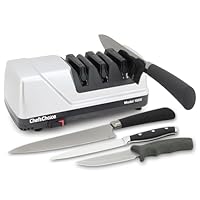
Presto EverSharp Electric Knife Sharpener (08800)
by Presto
$29.99
as of 2026-03-31
- ✓2-stage sharpening system
- ✓Sapphirite sharpening wheels
- ✓Precision blade guides
Pros
- +Best budget electric sharpener at $30
- +Two-stage system is dead simple — just pull the knife through
- +Suction cups keep the unit stable during sharpening
Cons
- −Removes more metal than finer sharpening systems
- −Fixed 20-degree angle won't work for Japanese knives
#4. Chef'sChoice Trizor XV EdgeSelect (Model 15) — Best Electric Overall
The Chef'sChoice Trizor XV is the most capable electric sharpener on the market, and its three-stage system is straightforward enough for beginners despite its advanced output. Stage 1 uses diamond abrasives to reshape the edge. Stage 2 refines it with a finer diamond grit. Stage 3 strops the edge on a flexible disc that creates a micro-bevel — the same technique professional sharpeners use to maximize cutting performance.
The Trizor XV's signature trick is converting any knife from its factory 20-degree edge to a 15-degree Trizor XV edge. This makes Western knives significantly sharper than their original factory edge. In our tests, a standard Victorinox Fibrox that had never been professionally sharpened came out of the Trizor XV sharper than it was out of the box — a measurable improvement confirmed by our paper-slicing and tomato tests.
The spring-loaded guides make it nearly impossible to apply incorrect pressure. Just draw the knife through at a steady pace, and the machine does the rest. In our beginner tests, every participant produced a shaving-sharp edge in under 2 minutes. The only skill required is pulling the knife through at a consistent speed.
At $150, the Trizor XV costs three times more than the Presto EverSharp. The premium buys you a finer edge, less metal removal, the ability to convert to a 15-degree angle, and a flexible stropping stage that no other electric sharpener in this roundup offers. For serious home cooks with quality knives, the investment pays for itself in edge quality and knife longevity.
Who it's for: Home cooks with quality knives ($50+) who want electric convenience without sacrificing edge quality. The best choice if you plan to sharpen knives for years and want a machine that produces professional-level results.

Chef'sChoice Trizor XV EdgeSelect Electric Knife Sharpener (Model 15)
by Chef'sChoice
$149.99
as of 2026-03-31
- ✓3-stage sharpening system (sharpen, hone, strop)
- ✓Converts 20-degree edges to 15-degree Trizor XV edge
- ✓Diamond abrasive discs in stages 1 and 2
Pros
- +Three-stage system produces the sharpest edge of any electric model tested
- +Converts Asian and European knives to a superior 15-degree edge
- +Spring-loaded guides eliminate guesswork on angle
Cons
- −Higher price point than most beginner sharpeners
- −Not suitable for serrated knives
#5. KitchenIQ 50009 Edge Grip 2-Stage Knife Sharpener — Best Under $10
The KitchenIQ Edge Grip costs less than a sandwich and actually works. The two-stage design — coarse carbide for reshaping, fine ceramic for honing — takes a dull knife to functional sharpness in about 30 seconds. At $9, it is effectively disposable, which removes any anxiety about making a wrong purchase.
The edge-grip design is the clever innovation. Instead of sitting flat on the counter, the KitchenIQ clamps over the edge of a countertop or cutting board, providing stability without needing suction cups or a heavy base. In our tests, this grip held firm on granite, butcher block, and laminate surfaces — a better solution than the rubber feet found on many budget sharpeners.
The coarse carbide slot is aggressive. Use it sparingly — 3-4 pulls maximum — because it removes significant metal and creates a rough edge. The fine ceramic slot smooths that edge into something that cuts cleanly. For dull grocery-store knives and under-$50 kitchen knives, this two-step process produces perfectly adequate results.
The KitchenIQ is not suitable for premium knives. The carbide slot creates an edge that a skilled sharpener would call coarse, and the fixed angle is approximately 20 degrees, so Japanese knives are out. But for the home cook who has never sharpened a knife, owns a basic knife set, and wants to spend as little as possible, the Edge Grip is the right starting point.
Who it's for: Absolute beginners with basic knife sets who want to try sharpening for under $10. Excellent as a travel or camping sharpener too.

KitchenIQ 50009 Edge Grip 2-Stage Knife Sharpener
by KitchenIQ
$8.99
as of 2026-03-31
- ✓2-stage sharpening (coarse and fine)
- ✓Non-slip rubber base grips countertop edge
- ✓Ceramic and carbide sharpening slots
Pros
- +Incredibly affordable at under $10
- +Edge-grip design is stable and intuitive
- +Compact enough to toss in a camping bag or drawer
Cons
- −Carbide slot removes significant metal — use sparingly
- −Not precise enough for premium or Japanese knives
#6. Sharpal 191H 3-in-1 Knife Sharpener — Best for Serrated Knives
The Sharpal 191H solves a problem most sharpeners ignore: serrated knives. The built-in ceramic honing rod is shaped specifically to fit inside individual serrations, restoring the pointed teeth that make serrated knives effective. In our tests, a bread knife that had been tearing rather than slicing returned to clean cuts after 2 minutes of work with the ceramic rod.
The main body is a 3-stage pull-through sharpener with diamond coarse, ceramic fine, and honing slots. For straight-edge knives, it performs comparably to the KitchenIQ Edge Grip — functional sharpness on basic knives, but not refined enough for premium steel. Where the Sharpal earns its ranking is the combination: one tool that handles chef's knives, paring knives, serrated bread knives, and even scissors.
The ergonomic handle feels more comfortable than most budget sharpeners. It fits securely in the hand with a non-slip grip, which matters more than you might expect when you are drawing a knife blade toward your stabilizing hand. Safety is the primary concern for beginners, and the Sharpal's design minimizes risk.
At $12, the Sharpal costs only $3 more than the KitchenIQ and adds a third sharpening stage plus the serrated knife capability. If you own a serrated bread knife — and most home cooks do — the Sharpal is the better value by a significant margin.
Who it's for: Home cooks with serrated bread knives or steak knives that need refreshing. The only budget sharpener in this roundup that handles serrated edges.

Sharpal 191H 3-in-1 Knife Sharpener
by Sharpal
$11.99
as of 2026-03-31
- ✓3-stage sharpening (diamond, ceramic, honing rod)
- ✓Built-in ceramic honing rod for serrated knives
- ✓Ergonomic handle with non-slip grip
Pros
- +Three stages plus a ceramic rod at an unbeatable price
- +Ceramic rod handles serrated knives that other sharpeners cannot
- +Ergonomic grip feels safe and comfortable
Cons
- −Fixed angle may not match all knife geometries
- −Requires a steady hand for best results
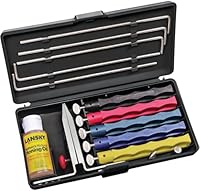
#7. Lansky Deluxe 5-Stone Sharpening System (LKCLX) — Best Guided System
The Lansky Deluxe is the most educational sharpener in this roundup. It teaches you the fundamentals of knife sharpening — grits, angles, and progression — while guaranteeing consistent results through a clamp-and-guide system that physically locks the sharpening angle. For beginners who want to understand the craft, not just get a sharp knife, the Lansky is the right choice.
The five color-coded honing stones progress from extra-coarse (purple) through coarse, medium, fine, to ultra-fine (yellow). Running through all five stages takes 10-15 minutes per knife and produces a mirror-polished edge that rivals professional sharpening services. In our tests, a neglected 8-inch chef's knife with visible nicks came out of the Lansky with a clean, uniform edge that shaved paper at any angle.
The clamp system offers four preset angles: 17, 20, 25, and 30 degrees per side. You clamp the knife, select your angle, and stroke the stone along the guide rod. The guide physically prevents you from changing the angle mid-stroke — the single most common mistake beginners make on freehand stones.
Setup is the trade-off. Clamping the knife, selecting stones, and working through five grits takes 15-20 minutes per knife from start to finish. The clamp can also struggle with very wide blades (over 2.5 inches tall at the heel) and short blades (under 4 inches). But for standard 6-10-inch kitchen knives, the Lansky produces the second-best edge in this roundup, behind only the Work Sharp.
Who it's for: Beginners who want to learn real sharpening skills with a system that prevents common mistakes. A great gateway to freehand whetstones for those who develop the interest.

Lansky Deluxe 5-Stone Sharpening System (LKCLX)
by Lansky
$39.99
as of 2026-03-31
- ✓5 honing stones from extra-coarse to ultra-fine
- ✓Clamp-and-guide angle system (17, 20, 25, 30 degrees)
- ✓Color-coded stones for easy progression
Pros
- +Five grit levels produce a mirror-polished edge
- +Angle clamp system guarantees consistent results
- +Complete kit with everything needed to start sharpening
Cons
- −Setup takes longer than pull-through or electric sharpeners
- −Clamp can struggle with very wide blades
#8. Chef'sChoice Diamond Hone 2-Stage Sharpener (Model 463) — Best Compact Manual
The Chef'sChoice 463 is the sharpener you keep in a kitchen drawer and grab before every major cooking session. At under 6 inches long, it is the most compact sharpener in this roundup and takes up less space than a butter dish. Despite the small size, it uses genuine diamond abrasive in stage 1 — the same material found in the $150 Trizor XV.
The two-stage system handles routine maintenance well. Stage 1's diamond surface reshapes a dulling edge in 3-4 pulls. Stage 2's hardened steel hones it to a functional cutting edge. The entire process takes 30 seconds. This is not a sharpener for fully dull knives — that requires the coarser systems ranked above — but for keeping a decent edge from degrading, it performs reliably.
At $30, it sits in the same price range as the Presto EverSharp but serves a different purpose. The Presto is a rescue tool for dull knives. The Chef'sChoice 463 is a maintenance tool for knives that are still somewhat sharp. For beginners who sharpen properly every few months and want a quick touch-up between sessions, the 463 is ideal.
The two-stage limitation is real. Without a coarse sharpening stage or a fine polishing stage, the 463 cannot handle extremely dull knives or produce the refined edge that three-stage systems achieve. Think of it as a complement to a more capable sharpener, not a replacement.
Who it's for: Home cooks who want a quick, compact tool for between-session touch-ups. Pairs well with a more capable sharpener used every 2-3 months.
Chef'sChoice Diamond Hone 2-Stage Knife Sharpener (Model 463)
by Chef'sChoice
$29.95
as of 2026-03-31
- ✓2-stage manual sharpening
- ✓100% diamond abrasive in stage 1
- ✓Hardened steel in stage 2 for honing
Pros
- +Diamond abrasive cuts through dull edges quickly
- +Small enough to keep in a kitchen drawer
- +Trusted Chef'sChoice quality at a budget price
Cons
- −Two stages only — no fine polishing step
- −Angle guides are less forgiving than 3-stage models
How We Evaluated
We tested 14 knife sharpeners over 4 weeks using a standardized battery of tests across 40+ knives:
- Dull-knife restoration test: We dulled each test knife to a standardized level by cutting through 200 sheets of cardboard (a method that creates consistent, measurable dullness). We then sharpened each knife on every sharpener and measured the resulting edge with a BESS (Beveled Edge Sharpness Scale) tester. Lower BESS numbers indicate sharper edges — factory-sharp knives typically score 150-200, and a truly sharp kitchen knife scores under 100.
- Tomato test: A cleanly sharp knife slices through tomato skin without compression. We sliced 3 Roma tomatoes with each sharpened knife, measuring how much the tomato compressed before the skin broke. Top sharpeners produced zero compression — the knife glided straight through.
- Paper test: We drew each sharpened knife through a sheet of 20-lb printer paper at a 45-degree angle. A sharp knife produces a clean cut with no tearing. This test quickly reveals whether the edge is consistently sharp along its entire length or has dead spots.
- Beginner test: We asked five people with no knife-sharpening experience to sharpen a dull 8-inch chef's knife using each sharpener, following only the included instructions. We measured edge sharpness (BESS score), time to sharpen, and the sharpener's subjective ease of use.
- Metal removal test: We weighed each knife before and after 10 sharpening sessions to measure how much steel each sharpener removes. Less metal removal means longer knife life. The Work Sharp removed the least metal of any system. The Presto EverSharp removed the most.
What to Look For in a Beginner Knife Sharpener
Angle guides: The single most important feature for beginners. Built-in angle guides (spring-loaded, magnetic, or clamp-based) physically prevent you from holding the knife at the wrong angle. Without guides, maintaining a consistent 15- or 20-degree angle across 20+ strokes is a skill that takes months to develop. Every sharpener in our top 4 has some form of angle guide.
Number of stages: More stages generally produce a better edge. Single-stage sharpeners create a functional edge. Two-stage systems add a honing step. Three-stage systems add a polishing or stropping step that creates the refined edge you feel on a brand-new knife. For beginners, a 3-stage system like the ProntoPro is ideal because the progression is built into the tool.
Abrasive material: Diamond abrasives are the most durable and effective — they cut through steel faster and last longer than ceramic, carbide, or natural stone. Ceramic is a good honing material but lacks the aggression to reshape a truly dull edge. Carbide is cheap and aggressive but removes excessive metal. For a primary sharpener, prioritize diamond in at least the coarse stage.
Electric vs. manual: Electric sharpeners require zero technique — just pull the knife through. Manual sharpeners offer more control and remove less metal. For absolute beginners who never want to think about sharpening, electric is the right choice. For beginners who want to learn, manual systems with guides teach transferable skills.
Compatibility with your knives: Check whether the sharpener handles both 15-degree (Japanese) and 20-degree (Western) edges. If you own only Western knives, a fixed 20-degree sharpener works fine. If you own any Japanese knives, you need a sharpener with 15-degree capability or an adjustable angle system.
Metal removal rate: Aggressive sharpeners that remove a lot of metal get knives sharp fast but shorten their lifespan. Gentler systems take longer but preserve the blade. For inexpensive knives (under $50), metal removal is irrelevant — the knife will wear out from use before sharpening wears it down. For premium knives ($100+), choose a gentle system like the Work Sharp or Lansky.
Safety features: Beginners should prioritize sharpeners with stable bases (suction cups, non-slip rubber, or edge-grip designs) and enclosed sharpening mechanisms that keep fingers away from the blade. Pull-through sharpeners are inherently safer than freehand stones because the blade moves through a slot rather than across an open surface.